Life On My Terms
Understanding and recognising brain health conditions, such as migraine. Visit us for more information and support.
This is a disease awareness website for patients developed by Lundbeck Ltd.
THIS SITE IS FOR UK MIGRAINE PATIENTS WHO HAVE BEEN PRESCRIBED VYEPTI®▼ (EPTINEZUMAB)

If you get any side effects, talk to your doctor, pharmacist or nurse. This includes any possible side effects not listed in the package leaflet. You can also report side effects directly via the Yellow Card Scheme at https://yellowcard.mhra.gov.uk/. By reporting side effects, you can help provide more information on the safety of this medicine.
▼This medicine is subject to additional monitoring. This will allow quick identification of new safety information. You can report side effects directly via the Yellow Card Scheme at https://yellowcard.mhra.gov.uk/ or search for MHRA Yellow Card in the Google Play or Apple App Store.
Please find full information on how to report a side effect on the bottom of this page.
Migraine is a severe and painful long-term health condition. Different people can get different symptoms. When you have a migraine attack it can impact your daily life.2


A moderate or severe headache, usually on one side of the head3

Nausea, vomiting and sensitivity to light, sound, or strong smells2

Attacks with or without aura (flashes of light, blind spots, or tingling in the hand or face, which may come on before or during migraine)3
People with migraine are split into two types – ‘episodic migraine’ and ‘chronic migraine’ – depending on how many migraines they get a month.4

Episodic migraine: headaches occur on 0–14 days per month4
Chronic migraine: headaches occur on at least 15 days per month for at least 3 months4
Living well with migraine
Making changes to your lifestyle and routine is one way to help reduce the impact of migraine on your daily life.5–7
Here are some migraine management strategies you may want to try:

Eating a healthy, balanced diet and drinking plenty of water5,7

Gradually reducing caffeine intake (if you think it’s a trigger)5

Maintaining a regular sleep pattern6

Being more active or exercising daily at a level you find manageable5,7

Avoiding bright lights, loud noises or strong smells5

A medicine for helping to prevent migraines before they start1
You and your healthcare professional have decided that you may benefit from VYEPTI treatment. VYEPTI contains the active substance eptinezumab, which blocks the activity of calcitonin gene-related peptide (CGRP), a naturally occurring substance in the body. People with migraine may have increased levels of this substance.
VYEPTI is given as a drip (infusion) into a vein.1

The recommended dose is 100 mg given every 12 weeks. Some patients may benefit from a dose of 300 mg given every 12 weeks. Your doctor will decide the right dose for you and how long you should continue to be treated.1

Your infusion will be given to you by a healthcare professional and will last about 30 minutes. Additional time will be needed to set up the IV infusion and your healthcare professional will observe you during and after the infusion in accordance with normal clinical practice for signs of an allergic reaction.1

If you think you may miss your appointment or need to reschedule your infusion, contact your healthcare professional immediately to reschedule.

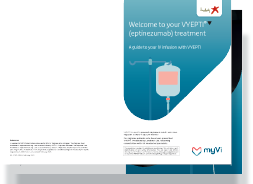
For more information about what you need to do on your infusion day, take a look at the VYEPTI infusion guide.
Like all medicines, VYEPTI can cause side effects, although not everybody gets them.1

Contact your doctor or nurse immediately if you have any of the following side effects – you may need urgent medical treatment.1
Common (may affect 1 in 10 people)
Allergic reactions and other reactions due to the infusion. Reactions can develop quickly during infusion but your healthcare professional will observe you during and after the infusion and take appropriate action if there are any signs of an allergic reaction.1
Symptoms of allergic reactions are:1
 Breathing difficulties
 Fast or
 Sudden drop in blood pressure making you feel dizzy or lightheaded
 Swelling of the lips or tongue
 Severe skin itching, rash
In an emergency call 999 or go immediately to A&E
Serious allergic reactions are uncommon (may affect up to 1 in 100 people).
Other symptoms that may occur due to the infusion include respiratory symptoms (e.g. blocked or runny nose,throat irritation, cough, sneezing, shortness of breath) and feeling tired. These symptoms are usually non-serious and of short duration.1
Other side effects can occur with the following frequency:
Common (may affect up to 1 in 10 people)
 Stuffy nose
 Sore throat
 Fatigue
Before taking VYEPTI, it’s important to tell your healthcare professional if any of the following are relevant to you:1

If you have any medical conditions, including disease affecting your heart and blood circulation

If you’re pregnant (or planning to become pregnant), or breastfeeding (or planning to breastfeed). You should avoid VYEPTI if you are, or trying to become, pregnant

If you’re using, have recently used, or might use any other medicines

Talk to your healthcare professional before taking any medications for side effects or migraine.
For full information please refer to your Patient Information Leaflet (PIL).


Understanding and recognising brain health conditions, such as migraine. Visit us for more information and support.
This is a disease awareness website for patients developed by Lundbeck Ltd.

Lundbeck UK has not been involved in the content development and approval of third party websites.
Do you want to continue?