

What is the
for VYEPTI?
VYEPTI significantly reduced frequency of monthly migraine days (MMDs) vs placebo2–4
Mean change from baseline in MMDs in adult patients with chronic migraine2*
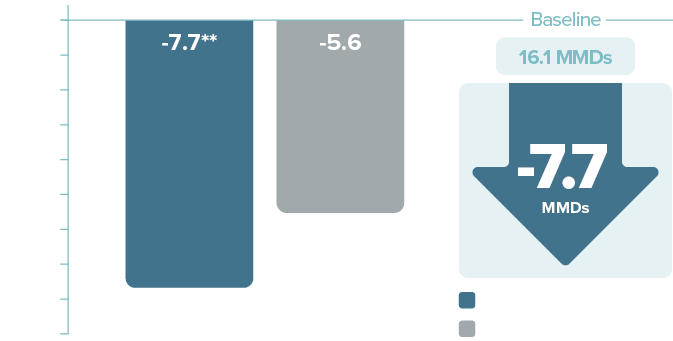
**p<0.0001 vs placebo.
Adapted from Lipton RB, et al. Neurology. 2020.
 View Lipton RB, et al. Neurology. 2020 Clinical Summary
*PROMISE-2 studied patients with chronic migraine; the mean number of MMDs at baseline was ~16.1 across treatment groups. VYEPTI 100 mg significantly reduced MMDs in patients with chronic migraine across Weeks 1–12 compared with placebo (100 mg -7.7 vs placebo -5.6 days, p<0.0001).2
Mean change from baseline in MMDs in adult patients with episodic migraine3
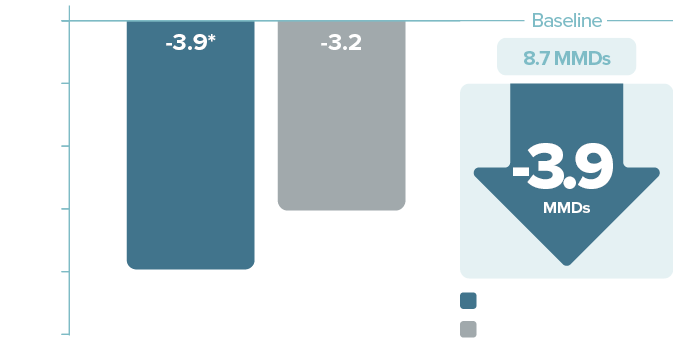
*p=0.0182 vs placebo.
Adapted from Ashina M, et al. Cephalalgia. 2020.
View Ashina M, et al. Cephalalgia. 2020 Clinical Summary
*PROMISE-1 studied patients with episodic migraine; the mean number of MMDs at baseline was ~8.6 across treatment groups. VYEPTI 100 mg significantly reduced MMDs in patients with episodic migraine across Weeks 1–12 compared with placebo (100 mg -3.9 vs placebo -3.2 days, p=0.0182).3

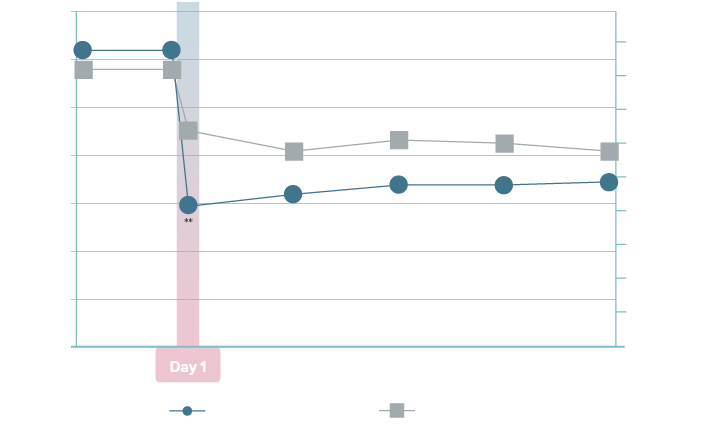
VYEPTI starts working FAST, from day 1 after infusion5*
Day 1 reduction in the proportion of patients experiencing chronic migraine compared with baseline5
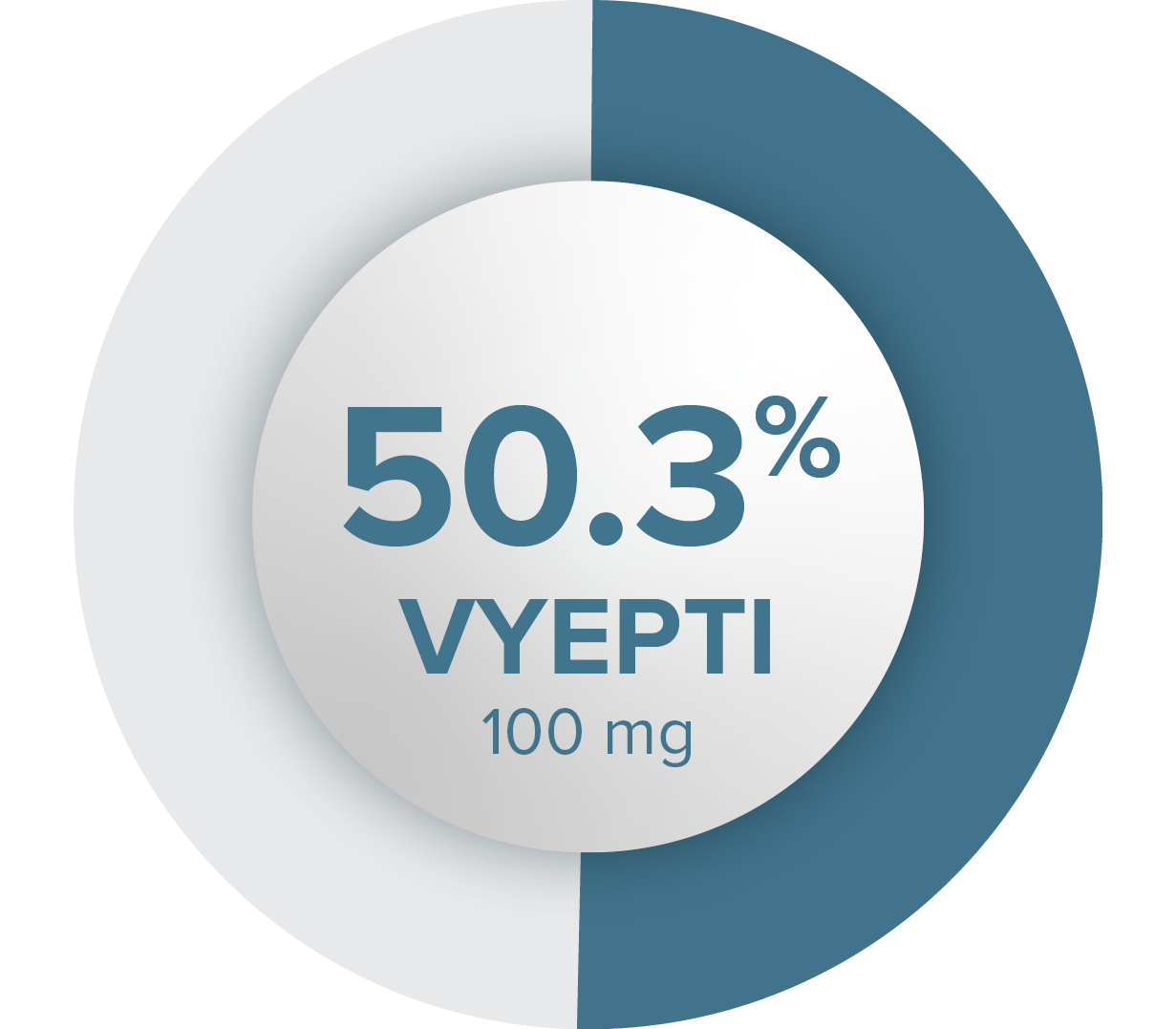
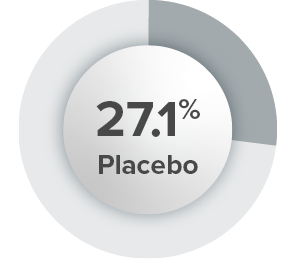
*Reduced risk of migraine on Day 1 after infusion.5
†Values for Weeks 1 through 4 calculated as the average daily percentage of patients with a migraine during that week. Normalisation to average monthly days was achieved by multiplying the daily percent by 28 days (baseline period). Data shown for VYEPTI 100 mg and placebo only.5 VYEPTI 300 mg is not available in the UK.
Average daily percentage of patients with chronic migraine experiencing migraine5†
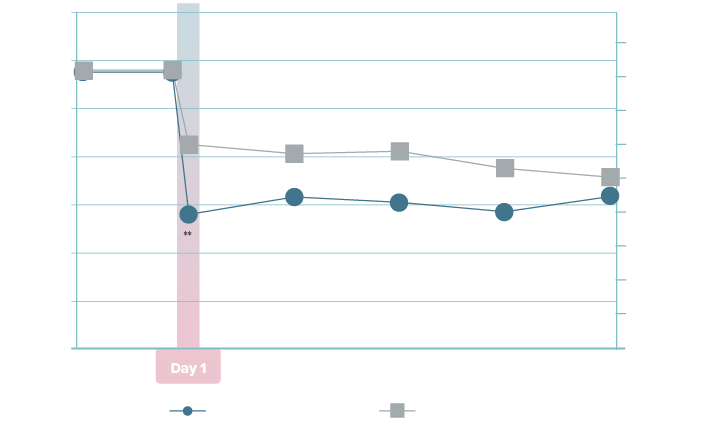
**p<0.001 vs placebo.
Adapted from Dodick DW, et al. Headache. 2020.
 View Dodick DW, et al. Headache. 2020 Clinical Summary
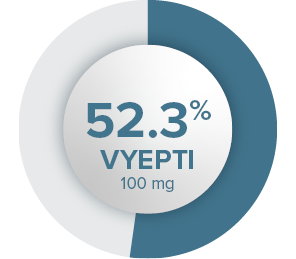
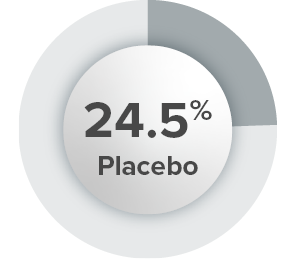



In migraine patients with 2–4 prior preventive treatment failures
VYEPTI delivered sustained migraine prevention over 18 months6*
Mean change from baseline in MMDs in patients with episodic migraine6
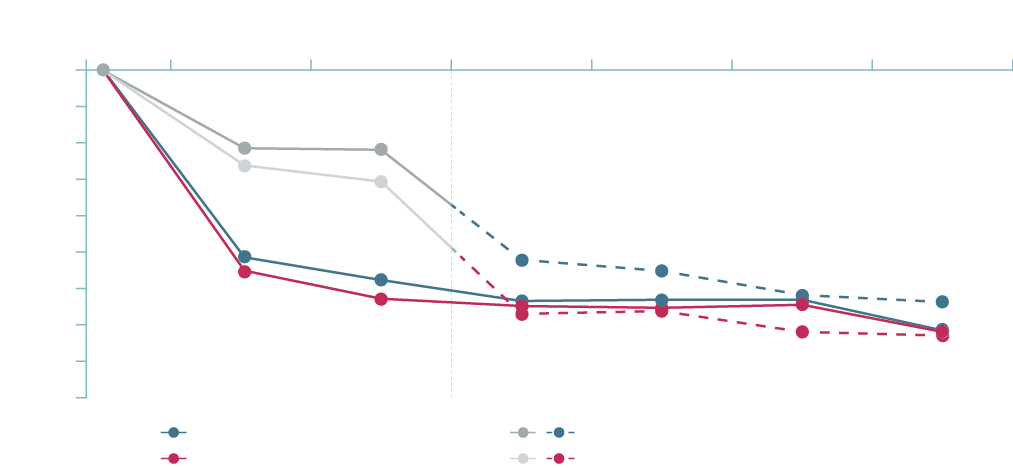
*p=0.0182 vs placebo.
Adapted from Ashina M, et al. J Headache Pain. 2023.
View Ashina M, et al. J Headache Pain. 2023 Clinical Summary

VYEPTI allows patients with migraine to maintain reduced use of acute medication for up to 18 months6†
The extension phase of the DELIVER trial lacked a placebo or active comparator arm. VYEPTI 300 mg is not available in the UK.
**DELIVER studied patients with episodic and chronic migraine with 2–4 prior preventive treatment failures (BL MMD of 13.8). Patients who completed the 24-week placebo-controlled period of DELIVER (VYEPTI 100 mg, VYEPTI 300 mg and placebo) received VYEPTI 100 mg or 300 mg during the 48-week extension period. Patients initially randomised to VYEPTI continued their assigned dose.6
†In all groups, VYEPTI-treated patients used approximately 5 fewer days of acute migraine medication per month during the first dosing interval vs approximately 2 fewer days of use of acute medication per month with placebo. Use of acute medication remained at similarly reduced levels for the remainder of VYEPTI treatment.6
In patients with chronic migraine
VYEPTI delivered sustained reductions in migraine days with no wearing off observed7*
Mean weekly migraine days over the first dosing interval in adult patients with chronic migraine7
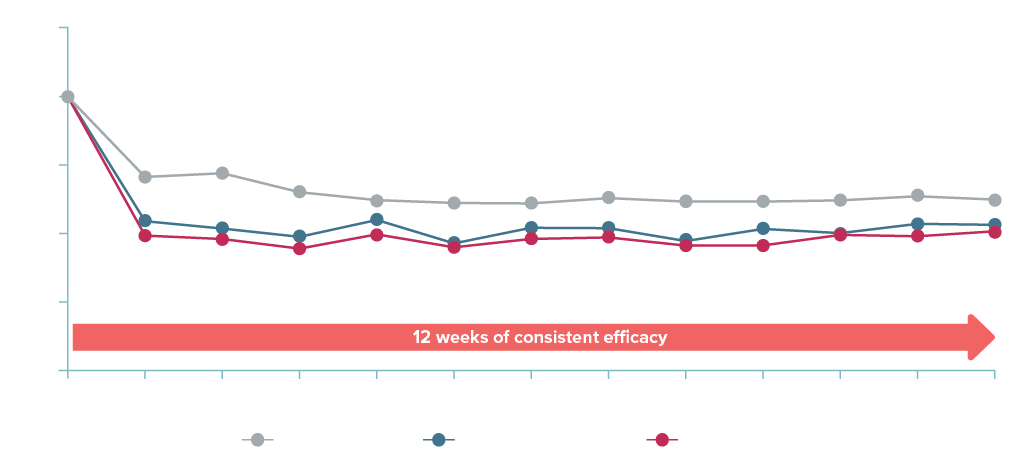
Adapted from Cady R, et al. Poster P13.009. AAN. 2023. Descriptive statistics. Formal statistical testing not performed.
View Cady R, et al. Poster P13.009. AAN. 2023 Clinical Summary
Weekly migraine day frequency was lower with VYEPTI at all time points, and with a similar magnitude, within the 12-week dosing interval7
VYEPTI 300 mg is not available in the UK.
*At population level, no observation of wearing off occurred for either VYEPTI 100 mg or 300 mg over the first dosing interval. A wearing off effect is defined as an initial positive response to treatment with a shorter duration than expected. In a post hoc analysis of the PROMISE-2 study evaluating migraine day frequency on a weekly basis, VYEPTI provided immediate and sustained reduction in migraine frequency in patients with chronic migraine, starting on the day after infusion and maintained for 12 weeks.7
VYEPTI IS GENERALLY WELL TOLERATED IN PATIENTS WITH MIGRAINE1,8

The most common side effects are hypersensitivity reactions, infusion related reaction and fatigue. Most hypersensitivity reactions occurred during infusion and were not serious (reported in ~4% of VYEPTI patients and 2% of placebo patients in clinical studies). Infusion-related reactions occurred infrequently and in similar proportions of VYEPTI and placebo patients (<1%). Fatigue was most frequent on the day of the first infusion, and reported in ~3% of VYEPTI patients and 2% of placebo patients1

The treating healthcare professional should observe or monitor patients during and after the infusion in accordance with normal clinical practice1

Which of your patients
could benefit from VYEPTI?

CONTACT US
LET'S
CONNECT
Schedule a meeting about VYEPTI with your local Lundbeck representative

HERE
TO HELP
Contact us with any general or
product-related queries

STAY
IN TOUCH
To receive information and
updates about VYEPTI,
sign up for promotional
communications from Lundbeck